About Geist Science
Geist Science is a registered independent organization delivering supports and services to education professionals and researchers around the world. We are a publisher in alliance with association of Scientists, Research Scholars and Professors of multidisciplinary fields like Management, Applied Science, Education, Computer Science and Mathematics. Geist Science helps researchers by guiding them on right direction in their research with the help of its worldwide research association members.
We are engaged with researchers and academicians all around the world. We provide a platform for researchers of all backgrounds and regions to help them display their contributions in multidisciplinary fields. At Geist Science, we seek to achieve finest publishing services for both authors and readers. Authors and editors are of principle importance. At Geist Science, we maintain multidisciplinary editorial board which makes us unique and helps improving the content quality published under Geist Science publications. We also provide useful insights and advices for potential book / journal authors publishing with Geist Science publications.
Geist Science is a non-profit organization and believes in free publication and access of academic literatures to research students.
About the Journal
Journal of Education & Social Sciences (JESS) is an open access blind peer-reviewed, bi-annual research journal freely available online. The purpose of this Journal is to publish quality research work in the disciplines of Education and Social Sciences defined in the classical sense, that is in the social sciences, the humanities, and the natural sciences. The research that is published may take a theoretical or speculative model as well as statistical and mathematical. Contributions are welcome from all fields which have relevant and insightful comments to make about the social sciences. The ever-increasing requirement of social scientists and educationalists, JESS covers a wide range of areas and themes comes under the ambit of Education and Social Sciences. The JESS aims to publish research manuscripts, which meet the standards of quality research work. Efforts and inputs are appreciated from all areas, which are pertinent and fruitful, and also contribute to expanding the horizon for future research.
Each article accepted after peer review process is made freely available online immediately upon publication, is published under a Creative Commons license and will be hosted online in perpetuity.
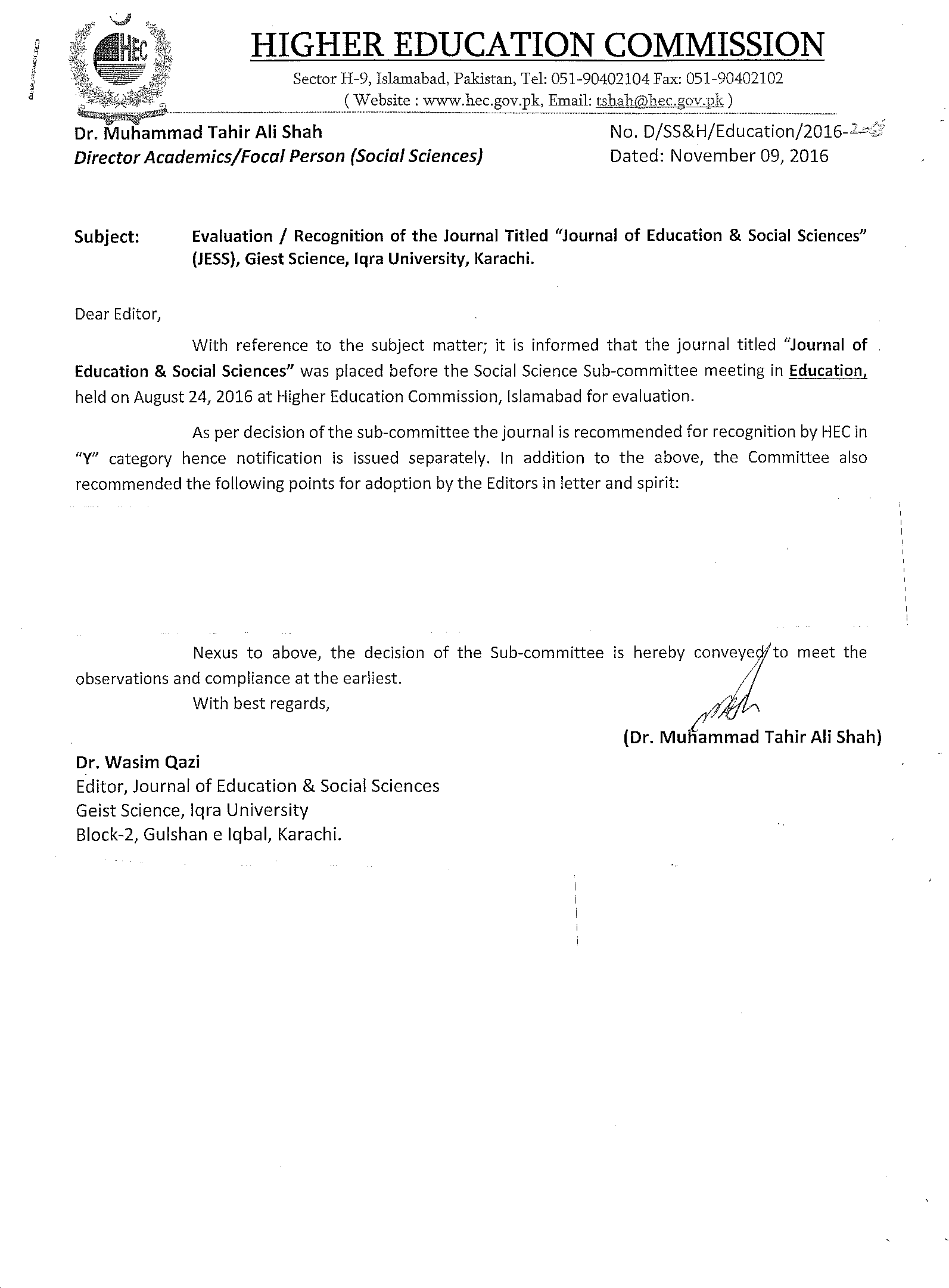
Journal of Education & Social Sciences (JESS) is a HEC funded and recognized journal owned by Geist Science. The editorial team of JESS is deeply grateful to HEC for its generous funding and intellectual guidance in running the journal successfully.
All submitted research papers and articles will be checked for originality using a solution from our partner Ithenticate.
JESS does not have article processing fee/charges (APCs).
JESS does not have article submission fee/charges.
JESS has applied for the membership of COPE
Subject Areas: Inclusive Education, Early Childhood Education, ICT in Education, Economics of Education, Education Leadership and Management, Sociology of Education, Curriculum Development, Pedagogy, Linguistics, and other Social Science related areas.
ISSN: 2410-5767 (Online) ISSN: 2414-8091 (Print) Online Since 2013
2 Issues per Year

This work by Geist Science is licensed under a Creative Commons Attribution 4.0 International License.
Editorial Team
Editors
Wasim Qazi, IQRA University, PK
Margret Madden, Australian Catholic University, AU
[email protected]
Managing Editor
Martin Thomas, IQRA University, PK
Associate Editors
Ismail Saad, IQRA University, PK
James Downhour, Southern Illinois University, USA
Editorial Board
Nabi Bux Jumani, International Islamic University, PK
Anthony L. Cashio, University of Manchester, UK
Randall E. Auxier, Southern Illinois University, USA
Parveen Munshi, University of Sindh, PK
Edwina Bensal, De La Salle University, PHIL
Fatima Dar, IQRA University, PK
Irshad Ahmed Farrukh, IER Punjab University, PK
Robert Griffin, Oklahoma City University, USA
Omer Mahfoodh, University Sains Malaysia, MY
Muhammad Fareed Dar, NED University of Engineering & Technology, PK
Imtiaz Jam, University of Karachi, PK
Anjum Bano Kazimi, IQRA University, PK
Sherwood Thompson, Eastern Kentucky University, USA
Munir Moosa, Sindh Madressatul Islam, PK
Kathryn F. Markovchick, Syntiro, USA
Thomas Voon Foo, Literacies & Translation, University Sains Malaysia, MY
Tanveer Anjum, IQRA University, PK
Pamela S. Flood, Forman S. Acton Educational Foundation, USA
Nasim Qaisrani, IQRA University, PK
Les Kirkham, IATEFL, UK
Editorial Office Address
IQRA University,
Block 2, Gulshan-e-Iqbal,
Karachi Pakistan
Author Guidelines
The Journal of Education & Social Sciences (JESS) is a multidisciplinary journal in the field of Education & Social Sciences. The goal of JESS is to publish intuitive, original and impactful research in the relevant arena.
JESS welcomes submissions of research manuscripts in any sub-domains of Education and Social Sciences. Within our scope are all aspects of management related to strategy, innovation, inclusive education, early childhood education, ICT in education, economics of education, educational leadership and management, curriculum development and pedagogy, and organizations as well as all functional areas of education. JESS also welcome articles within the scope of social sciences. A free online access and free publication make it easily available. A high-quality Double-Blind Peer review ensures its quality and original contributions in the field of management sciences.
We encourage authors to refer to the Committee on Publication Ethics' International Standards for Authors and view the Publication Ethics International Standards for Authors
Also, read Guidelines published on good publication and the Code of Conduct by the Committee of Publication Ethics (COPE).
SUBMIT MANUSCRIPT
The Journal of Education & Social Sciences facilitates its authors with a web-based submission and review process, enabling authors to submit and check the status of their papers online. Please read the following instructions for authors before moving on to the actual submission process (at Submit a Paper)
PRE-SUBMISSION ENGLISH-LANGUAGE EDITING
Authors for whom English is a second language may choose to have their manuscript professionally edited before submission to improve the English. An independent editing service can be found at Language Lab.
All services are paid for and arranged by the author, and use of this service does not guarantee acceptance or preference for publication.
ALL PAPERS MUST BE SUBMITTED VIA THE ONLINE SYSTEM
IMPORTANT: All papers will be acknowledged on receipt by email and will receive a preliminary editorial review within four weeks. Papers of high interest will be sent out for external review. We aim to notify authors of acceptance, rejection or need for revision within four months of submission. Recently, due to the high volume of submissions and demands on referees, it may not always be possible to meet this target, but we aim to have your manuscript reviewed within six months.
COPYRIGHT AND PERMISSIONS
Copyright Transfer Agreement
If your paper is accepted, the author identified as the formal corresponding author for the paper will receive an email prompting them to complete the license agreement on behalf of all authors on the paper.
Reporting standards
Authors of original research should present an accurate account of the work performed as well as an objective discussion of its significance. Underlying data should be represented accurately in the paper. A paper should contain sufficient detail and references to permit others to replicate the work. Fraudulent or knowingly inaccurate statements constitute unethical behavior and are unacceptable.
Data Access and Retention
Authors are asked to provide the raw data in connection with a paper for editorial review, if practicable, and should in any event be prepared to retain such data for a reasonable time after publication.
Originality and Plagiarism
The authors should ensure that they have written entirely original works, and if the authors have used the work and/or words of others that this has been appropriately cited or quoted.
Acknowledgement of Sources
Proper acknowledgment of the work of others must always be given. Authors should cite publications that have been influential in determining the nature of the reported work.
Authorship of the Paper
Authorship should be limited to those who have made a significant contribution to the conception, design, execution, or interpretation of the reported study. All those who have made significant contributions should be listed as co-authors. Where there are others who have participated in certain substantive aspects of the research project, they should be acknowledged or listed as contributors. The corresponding author should ensure that all appropriate co-authors and no inappropriate co-authors are included on the paper, and that all co-authors have seen and approved the final version of the paper and have agreed to its submission for publication.
Disclosure and Conflicts of Interest
All authors should disclose in their manuscript any financial or other substantive conflict of interest that might be construed to influence the results or interpretation of their manuscript. All sources of financial support for the project should be disclosed.
Fundamental errors in published works
When an author discovers a significant error or inaccuracy in his/her own published work, it is the author’s obligation to promptly notify the journal editor and cooperate with the editor to retract or correct the paper.
Policies
The Journal of Education and Social Sciences (JESS) is a biannual blind peer review journal with no submission and publication fee in the field of education and social science. The goal of JESS is to publish intuitive, original and impactful research in the relevant arena. JESS is multidisciplinary in scope, and interdisciplinary in content and approach.
JESS welcomes submissions of research manuscripts in any sub-domains of education and social sciences
- Peer-review process
- Publication Ethics Policy and Publication malpractice statement.
2.1 EDITOR'S GUIDELINES
2.2 REVIEWER'S GUIDELINES
2.3 AUTHOR'S GUIDELINES
1. Peer-review process
The peer review process facilitates a fair hearing for a manuscript among members of the scientific community. More practically, it helps editors decide which manuscripts are suitable for their journals. Peer review often helps authors and editors improve the quality of reporting.
We believe that manuscripts submitted to our journal are privileged communications that are authors' private, confidential property, and authors may be harmed by premature disclosure of any or all of a manuscript details.
Reviewers therefore are asked to keep manuscripts and the information they contain strictly confidential. Reviewers must not publicly discuss authors' work and must not appropriate authors' ideas before the manuscript is published. Reviewers must not retain the manuscript for their personal use and should destroy copies of manuscripts after submitting their reviews to the editor.
Reviewers are expected to respond to requests to review and to submit reviews within the agreed time frame. Reviewer's comments should be constructive, honest, and polite.
Back to top
2. Publication Ethics Policy and Publication malpractice statement.
2.1 EDITOR'S GUIDELINES
2.1.1 Publication decision
The editor of the JESS is responsible for deciding which of the articles submitted to the journal should be published. The editor may confer with other editors or reviewers in making this decision.
2.1.2 Fair play
An editor at any time evaluate manuscripts for their intellectual content and contribution to the existing knowledge, without regard to race, gender, religious belief, ethnic origin, citizenship, or political philosophy of the authors.
2.1.3 Confidentiality
The editor and any editorial staff of JESS must not disclose any information about a submitted manuscript to anyone other than the corresponding author, and the reviewers.
Disclosure and Conflicts of Interest
Unpublished materials disclosed in a submitted manuscript must not be used in an editor own research without the express written consent of the author.
2.2 REVIEWER'S GUIDELINES
2.2.1 Contribution to Editorial Decision
Peer review assists the editor in making editorial decisions and through the editorial communications with the author may also assist the author in improving the paper.
2.2.2 Promptness
The review should be carried out within the agreed timeframe. Further, any selected referee who feels unqualified to review the research reported in a manuscript or knows that its prompt review will be impossible should notify the editor and excuse himself from the review process.
2.2.3 Confidentiality
Any manuscripts received for review must be treated as confidential documents. They must not be shown to or discussed with others.
2.2.4 Disclosure and Conflicts of Interest
Privileged information or ideas obtained through peer review must be kept confidential and not used for personal advantage. Reviewers should not consider manuscripts in which they have conflicts of interest resulting from competitive, collaborative, or other relationships or connections with any of the authors, companies, or institutions connected to the papers.
2.2 AUTHOR'S GUIDELINES
2.3.1 Reporting standards
Authors of original research should present an accurate account of the work performed as well as an objective discussion of its significance. Underlying data should be represented accurately in the paper. A paper should contain sufficient detail and references to permit others to replicate the work. Fraudulent or knowingly inaccurate statements constitute unethical behaviour and are unacceptable.
2.3.2 Data Access and Retention
Authors are asked to provide the raw data in connection with a paper for editorial review, if practicable, and should in any event be prepared to retain such data for a reasonable time after publication.
2.3.3 Originality and Plagiarism
The authors should ensure that they have written entirely original works, and if the authors have used the work and/or words of others that this has been appropriately cited or quoted.
2.3.4 Acknowledgement of Sources
Proper acknowledgment of the work of others must always be given. Authors should cite publications that have been influential in determining the nature of the reported work.
2.3.5 Authorship of the Paper
Authorship should be limited to those who have made a significant contribution to the conception, design, execution, or interpretation of the reported study. All those who have made significant contributions should be listed as co-authors. Where there are others who have participated in certain substantive aspects of the research project, they should be acknowledged or listed as contributors. The corresponding author should ensure that all appropriate co-authors and no inappropriate co-authors are included on the paper and that all co-authors have seen and approved the final version of the paper and have agreed to its submission for publication.
2.3.6 Disclosure and Conflicts of Interest
All authors should disclose in their manuscript any financial or other substantive conflicts of interest that might be construed to influence the results or interpretation of their manuscript. All sources of financial support for the project should be disclosed.
2.3.7 Fundamental errors in published works
When an author discovers a significant error or inaccuracy in his/her own published work, it is the author's obligation to promptly notify the journal editor and cooperate with the editor to retract or correct the paper.
Back to top
Indexing
 Information Matrix for the Analysis of Journals